Physical Address
304 North Cardinal St.
Dorchester Center, MA 02124
Physical Address
304 North Cardinal St.
Dorchester Center, MA 02124

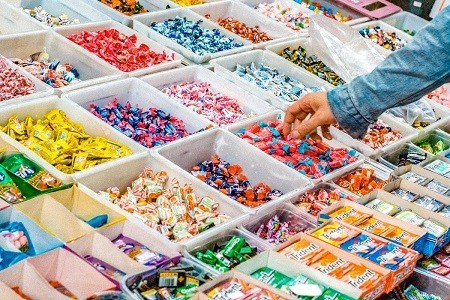
Candy industry statistics for 2026, including 2024 U.S. confectionery sales, jobs, facilities, market size, and key candy industry facts.

Candy remains one of the most durable categories in food and snacking. While older industry snapshots often focused on isolated sales totals from the late 2010s, the current confectionery market is much larger, with stronger seasonal demand, broader product innovation, and a sizable U.S. manufacturing footprint.
Quick Answer (2026): The U.S. confectionery industry recorded a record $54 billion in sales in 2024. The National Confectioners Association also says the industry supports about 58,000 direct manufacturing jobs, operates around 1,400 facilities, and contributes roughly $151 billion in total economic impact.
| Metric | Figure | Year |
|---|---|---|
| U.S. confectionery sales | $54 billion | 2024 |
| Direct manufacturing jobs | 58,000 | Current NCA estimate |
| Total jobs supported | 682,000 | Current NCA estimate |
| Manufacturing facilities | 1,400 | Current NCA estimate |
| Direct sales impact | $54 billion | Current NCA estimate |
| Total economic impact | $151 billion | Current NCA estimate |
The National Confectioners Association said U.S. confectionery sales reached a record $54 billion in 2024. That is a much stronger and more current benchmark than the older $35 billion U.S. sales figure in the original draft. It also shows that candy remains a major consumer category even in an environment shaped by inflation and shifting snack preferences.
NCA’s industry materials also say confectionery remains a broad category that includes chocolate, non-chocolate candy, gum, and mints. In other words, the “candy industry” is materially larger than many older online fact lists suggest.
NCA says the U.S. confectionery industry supports about 58,000 direct manufacturing jobs. When upstream and downstream effects are included, the association says the total rises to about 682,000 jobs supported across agriculture, transportation, retail, and related sectors.
The same NCA materials say the industry operates around 1,400 manufacturing facilities in the United States. That makes confectionery a meaningful domestic manufacturing category, not just a consumer packaged goods niche.
According to NCA, the industry generates about $54 billion in direct sales and roughly $151 billion in total economic impact. Those current figures replace the much older $44.6 billion economic-output statistic in your original post.
Global market estimates vary because research firms define “confectionery” differently. Fortune Business Insights estimated the global confectionery market at $220.85 billion in 2025, while Straits Research estimated it at $326.48 billion in 2025. The gap reflects methodology and category scope, but both estimates make one point clear: the global candy and confectionery market is far larger than the older sub-$60 billion sugar-confectionery framing in the original article.
Older candy posts often mix narrow “sugar confectionery” figures with broader “confectionery” or “snack” numbers. In 2026, the stronger SEO angle is to anchor the page to current NCA U.S. sales and economic-impact numbers, then add carefully labeled global market estimates for context.
The National Confectioners Association said U.S. confectionery sales reached $54 billion in 2024.
NCA says the industry supports about 58,000 direct manufacturing jobs and about 682,000 total jobs overall.
NCA says the industry operates around 1,400 manufacturing facilities in the United States.
Recent 2025 confectionery market estimates range from about $221 billion to $326 billion, depending on category scope and methodology.