Physical Address
304 North Cardinal St.
Dorchester Center, MA 02124
Physical Address
304 North Cardinal St.
Dorchester Center, MA 02124

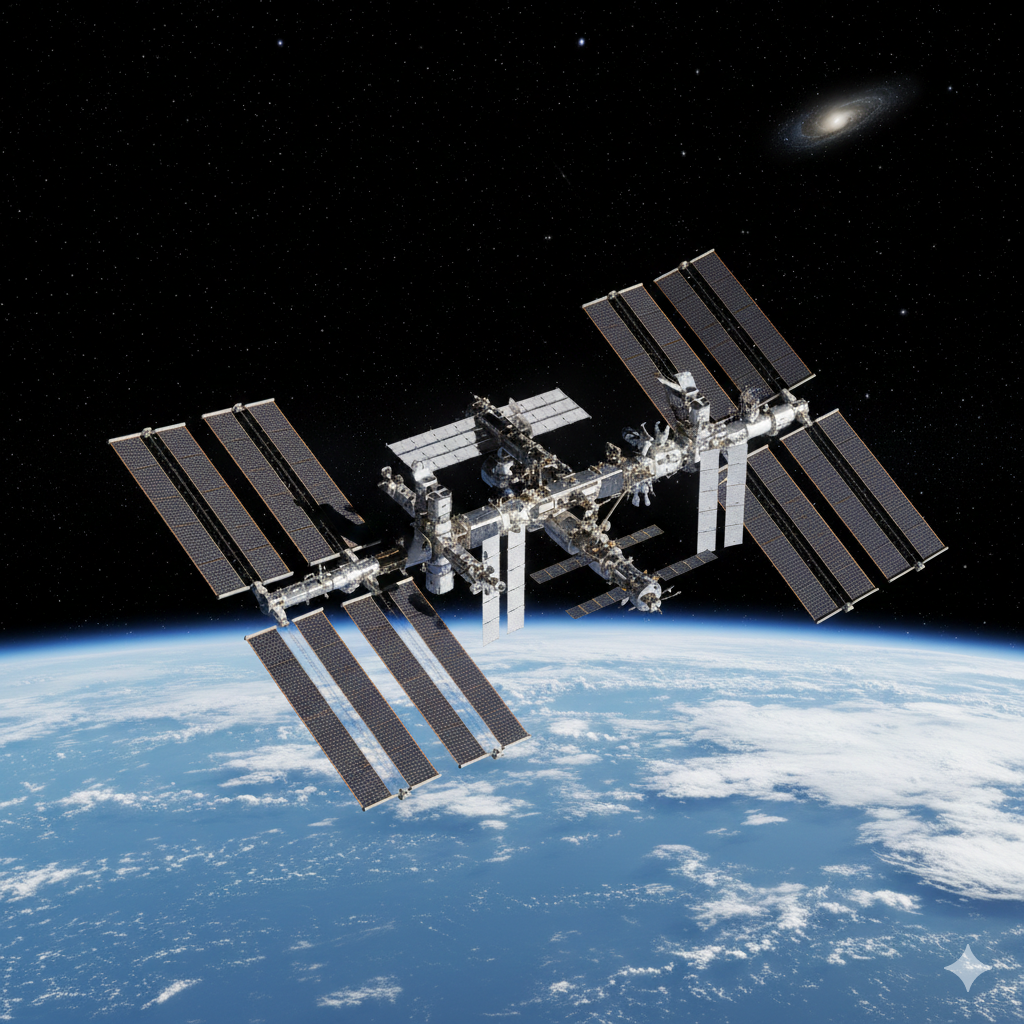
International Space Station (ISS) facts: launch timeline, continuous occupation since 2000, size and mass, orbit details, spacewalk totals, visitors by country, and NASA record holders.
The International Space Station (ISS) is a permanently crewed research laboratory in low Earth orbit built and operated through an international partnership led by NASA (United States), Roscosmos (Russia), ESA (Europe), JAXA (Japan), and CSA (Canada). NASA states the ISS has been continuously occupied since November 2000.
The station provides a microgravity environment used for research across human health, biology, physics, materials science, and technology demonstrations that support future exploration. NASA notes the ISS orbits Earth about 16 times per day, with an orbital period of roughly 90 minutes.
| Pressurized module length | 218 ft (67 m) |
| Truss length | 310 ft (94 m) |
| Solar array span (longitudinal arrays) | 239 ft (73 m) |
| Habitable volume (not including visiting vehicles) | 13,696 ft³ (388 m³) |
| Pressurized volume | 35,491 ft³ (1,005 m³) |
| Power generation | 8 solar arrays provide ~75–90 kW |
| Lines of software code (approx.) | ~1.5 million |
NASA: Space Station Facts and Figures
Total spacewalks at the ISS: NASA’s Station Overview reports 277 spacewalks conducted at the International Space Station since December 1998. (Because this number changes, use the NASA log below as the evergreen reference.)
Total visitors to the ISS: NASA reports 292 individuals representing 26 countries have visited the International Space Station.
NASA: Visitors to the Station by Country
NASA: Space Station Astronaut Record Holders
NASA states the station has been continuously occupied since November 2000.
NASA notes the ISS orbits Earth about 16 times per day (roughly one orbit every 90 minutes).
NASA lists the ISS as 356 feet (109 meters) end-to-end, with a pressurized volume of 35,491 cubic feet (1,005 cubic meters).