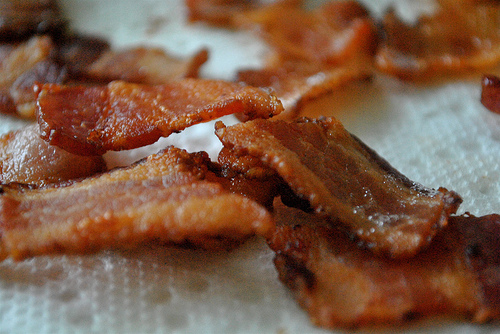
Photo by cookbookman17
Bacon is the ultimate crossover food: breakfast plates, burgers, salads, snacks—some people even put it on donuts. Part of the appeal is simple: it’s salty, smoky, crispy, and it makes other foods taste more “complete.”
But bacon isn’t just a cultural icon—it’s a big business, a menu staple, and (thanks to rising grocery prices) something many people now track like a real trend. Below are updated bacon facts and statistics, with older numbers kept only when they’re clearly labeled by year.
Bacon (Quick Facts)
Bacon is cured pork (most commonly pork belly) that’s typically smoked and sliced before cooking. In the U.S., it’s a massive category: trade reporting citing Circana pegs bacon at $6.9 billion in annual sales, and Datassential reports bacon appears on about 69% of menus. Grocery prices fluctuate, but the U.S. city average for sliced bacon was $6.978 per pound in January 2026.
Key Metrics Table: Bacon by the Numbers
| Metric | Stat | Year / Notes |
|---|---|---|
| Average retail price (U.S. city avg.) | $6.978 per lb | Jan 2026 (BLS via FRED series) |
| Annual bacon sales (U.S.) | $6.9B | Reported in 2025 trade coverage citing Circana; +4.4% YoY dollars |
| Record sales benchmark | Nearly $4B | 2013 U.S. sales (record at the time; +9.5% that year) |
| % of menus offering bacon | ~69% | Datassential “World of Bacon” report (2024) |
| Fast-food bacon milestone | ~25M Baconators sold in 8 weeks | 2007 Wendy’s reported figure |
Bacon Facts (Updated)
- Bacon is cured pork—often pork belly—and “cured” is the key.
Curing uses salt (and sometimes sugar and curing agents) to preserve meat and develop flavor. Smoking is common, but you’ll also see “uncured” labels (which typically still rely on curing ingredients from natural sources). - Bacon’s modern “sales boom” has receipts.
In 2013, U.S. bacon sales climbed 9.5% to a then-record of nearly $4 billion (historical benchmark). More recently, trade reporting citing Circana data puts bacon at $6.9 billion in annual sales, up 4.4% year over year. - Bacon is one of the most common menu proteins in the U.S.
Datassential’s “World of Bacon” reporting (2024) puts bacon on nearly 69% of menus—one reason it shows up everywhere from breakfast sandwiches to fancy salads and burgers. - Bacon prices are trackable like any other staple.
The U.S. city average price for sliced bacon was $6.978 per pound in January 2026, based on BLS pricing data published via FRED. - Bacon has a long global history (but exact “first bacon” claims vary).
Many food histories point to early salted/cured pork belly traditions in ancient China as an ancestor of bacon-like foods. Dating claims differ by source and by how strictly you define “bacon,” so it’s safest to describe it as “ancient cured pork traditions” rather than a single invention date. - Thick-cut vs. regular cut changes more than texture.
Thickness affects cook time, crispiness, and how bacon performs in sandwiches (thin = crisp fast; thick = meatier bite and better stand-alone). - Microwave bacon is a real behavior trend (historical snapshot).
An older pork retail report found 15% of bacon was cooked in a microwave (reported in the mid-2000s). It’s a useful “then vs. now” snapshot, but not a current measurement. - The Baconator helped fuel “bacon mania” in fast food.
Wendy’s reported selling nearly 25 million Baconators in the first eight weeks after launch (2007), a famous case study in bacon-powered product marketing. - Bacon is versatile because it’s a flavor “booster.”
Salt + smoke + rendered fat = instant depth. That’s why small amounts can transform dishes like roasted veggies, pasta, soups, and salads. - It’s smart to balance the fun with nutrition reality.
Bacon is typically high in sodium and saturated fat, so many people treat it as a “use it for flavor” food rather than an everyday protein.
 FAQ: Bacon Facts & Stats
 FAQ: Bacon Facts & Stats
How much does bacon cost in the U.S. right now?
Prices vary by region and brand, but the U.S. city average price for sliced bacon was $6.978 per pound in January 2026 (BLS pricing data via FRED).
How big is the bacon market in the U.S.?
Trade reporting citing Circana data puts U.S. bacon at about $6.9 billion in annual sales (reported in 2025 coverage). For historical context, bacon sales were nearly $4 billion in 2013 (record at the time).
What percentage of restaurants serve bacon?
Datassential’s 2024 “World of Bacon” reporting says bacon appears on nearly 69% of menus. Older studies reported different numbers, so it’s important to cite the year and source.
Is bacon the same as pancetta?
Not exactly. Bacon is commonly smoked (especially in the U.S.), while pancetta is Italian cured pork belly that is typically not smoked. Both are delicious—just different flavor profiles.
Why does bacon taste so good?
It combines salt, smoke, and fat—and when cooked, it develops browned flavors that amplify savory taste in everything it touches.
Bottom line: Bacon’s popularity isn’t just hype—it shows up in sales data, menu data, and grocery price tracking. Whether you’re Team Crispy or Team Thick-Cut, now you’ve got the facts to back up the obsession.