Physical Address
304 North Cardinal St.
Dorchester Center, MA 02124
Physical Address
304 North Cardinal St.
Dorchester Center, MA 02124

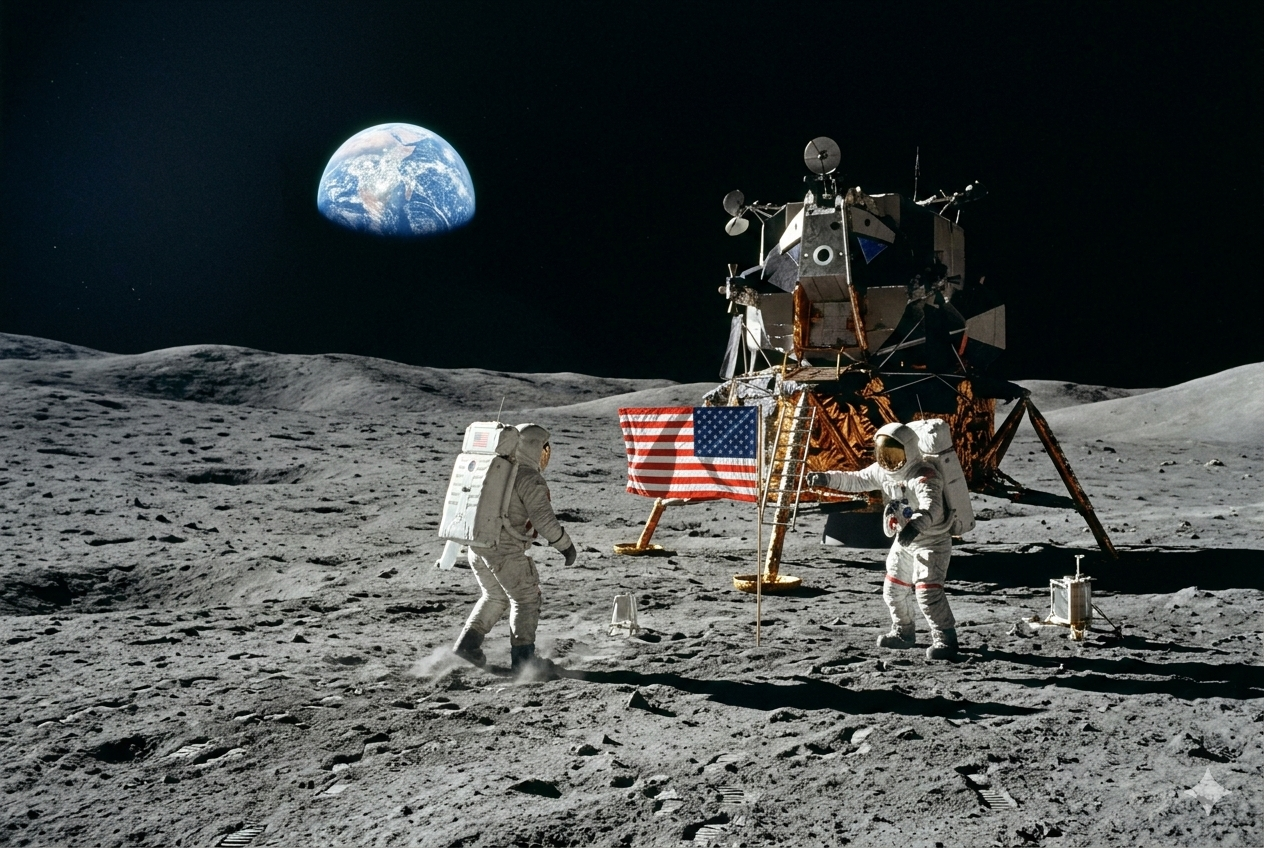
Apollo 11 put the first humans on the Moon in 1969. Explore the mission timeline, crew, call signs, landing site, key stats, and FAQs—plus a quick answer box and metrics table.
Apollo 11 was the United States mission that achieved the first crewed Moon landing—an event that reshaped science, technology, and global culture. Launched in July 1969, Apollo 11 carried three astronauts: Neil Armstrong, Michael Collins, and Edwin “Buzz” Aldrin. Armstrong and Aldrin descended to the lunar surface in the Lunar Module Eagle, while Collins remained in lunar orbit in the Command Module Columbia.
Below you’ll find a quick answer box, a key metrics table, and an updated list of Apollo 11 facts and statistics—written for fast scanning, easy sharing, and clear year labeling for historical numbers.
Apollo 11 launched July 16, 1969 from Kennedy Space Center and landed the first humans on the Moon on July 20, 1969 at the Sea of Tranquility. Neil Armstrong and Buzz Aldrin spent 21 hours, 36 minutes on the lunar surface, including a single moonwalk (EVA) lasting about 2.5 hours. The crew returned safely to Earth with about 21.6 kg (47.5 lb) of lunar samples and splashed down in the Pacific Ocean on July 24, 1969.
| Metric | Value | Year / Notes |
|---|---|---|
| Launch | July 16, 1969 — 9:32 a.m. EDT | Launch Complex 39A, Kennedy Space Center |
| Moon landing (LM touchdown) | July 20, 1969 | Mare Tranquillitatis (Sea of Tranquility) |
| Time on Moon’s surface | 21 hours, 36 minutes | 1969; includes time inside LM on the surface |
| Moonwalk (EVA) time | ~2.5 hours | 1969; time outside the LM |
| Lunar samples returned | ~21.6 kg (≈47.5 lb) | 1969; reported totals vary slightly by source/rounding |
| Mission duration | 8 days, 3 hours, 18 minutes, 35 seconds | 1969 |
| Total distance traveled | 953,054 miles | 1969; mission total reported in NASA overview |
| Estimated global TV audience | ~650 million viewers | 1969 estimate; commonly cited historical figure |
| Splashdown | July 24, 1969 — 12:50 p.m. EDT | Pacific Ocean; recovery ship: USS Hornet |
Apollo 11 was the culmination of NASA’s Apollo program goal: land humans on the Moon and return them safely to Earth. After launch on a Saturn V rocket, the spacecraft traveled to lunar orbit. Armstrong and Aldrin transferred into Eagle and landed at the Sea of Tranquility. Armstrong became the first person to step onto the Moon, followed shortly by Aldrin. They conducted one EVA, deployed early experiments, documented the site, and collected lunar material before lifting off to rendezvous with Collins in Columbia. The crew then returned to Earth for a Pacific Ocean splashdown and recovery.
“That’s one small step for [a] man, one giant leap for mankind.”
To complete the national goal set by President John F. Kennedy (announced May 25, 1961): perform a crewed lunar landing and return safely to Earth.
“Here men from the planet Earth first set foot upon the Moon. July 1969 A.D. We came in peace for all mankind.”
FAQ: Apollo 11Apollo 11’s Lunar Module Eagle landed on the Moon on July 20, 1969, at the Sea of Tranquility.
They spent 21 hours, 36 minutes on the lunar surface in total (including time inside the Lunar Module). Their moonwalk (EVA) lasted a little over two and a half hours.
The crew was Neil Armstrong (Commander), Michael Collins (Command Module Pilot), and Buzz Aldrin (Lunar Module Pilot).
Apollo 11 splashed down in the Pacific Ocean and was recovered by the USS Hornet. Historical reporting commonly describes the landing area as southwest of Hawaii.
There isn’t a single definitive count, but a widely cited historical estimate is about 650 million viewers worldwide (1969 estimate) for the first steps broadcast.